
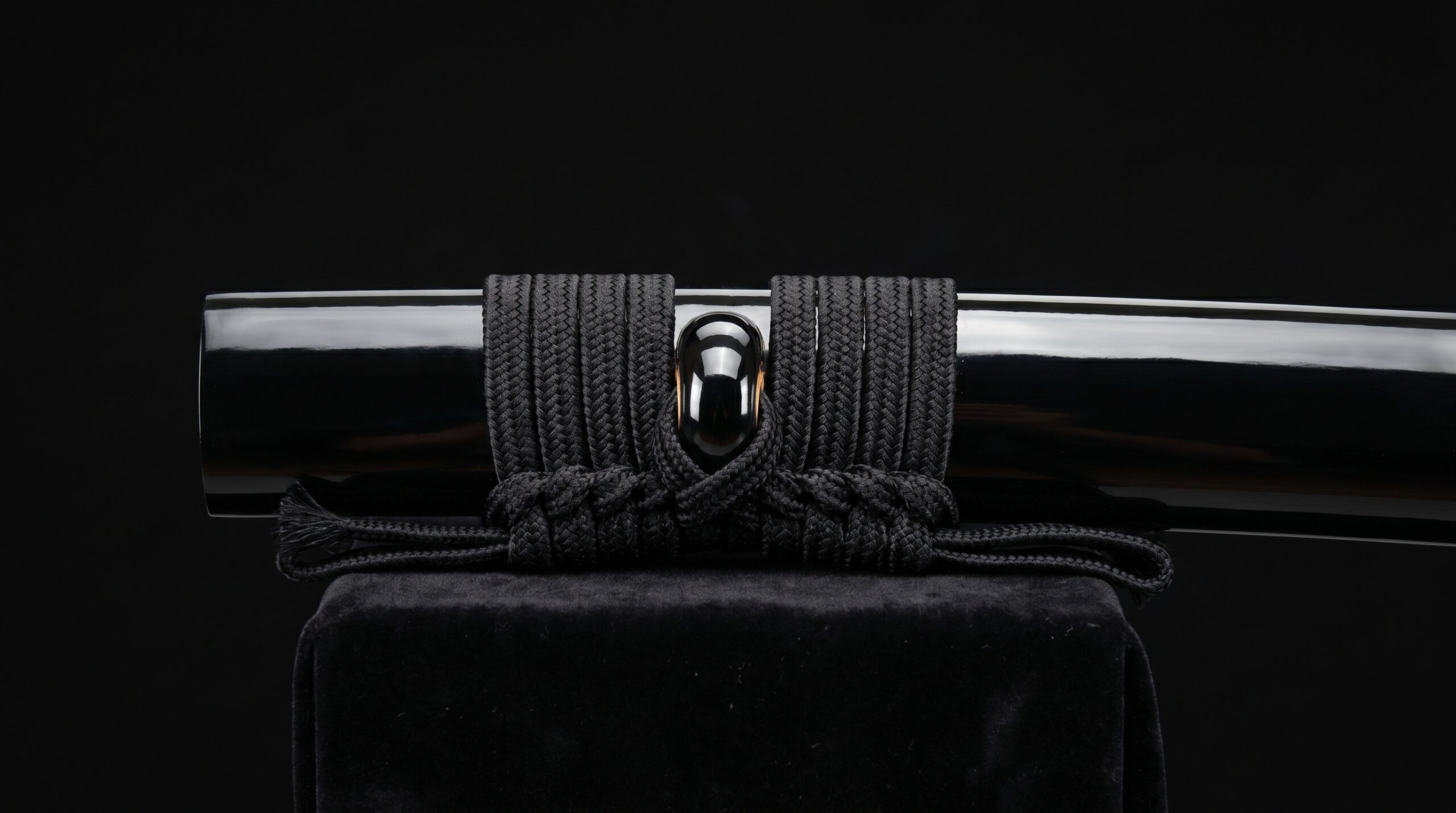
It is a small thing — a quiet little knob jutting from the side of the scabbard — and yet without it a samurai could not have walked across a courtyard with a katana through his belt. The kurikata is the unassuming anchor that ties everything together: the sword, the cord, the wearer’s obi, the daily reality of walking around armed. Look closely at any well-made katana saya and you will find this piece of carved wood or pressed horn doing more work than its size suggests, fixing the geometry of how the blade rides at the hip.
What is the Kurikata?
The kurikata (栗形), also commonly written kurigata, is the small protruding knob attached to the obi side of the saya, roughly two hand-widths below the koiguchi. The kanji literally means „chestnut shape,“ named for its slightly bulged, oval profile. Its single job is to anchor the sageo, the silk cord that ties the saya to the wearer’s obi. Without a kurikata, the sageo has nothing to grip, and the entire katana-on-the-hip arrangement collapses. For a broader context on the fittings that share the saya, see the Wikipedia entry for Japanese sword mountings, which illustrates the kurikata in situ.
Origins and Historical Function
The kurikata appears as a distinct fitting only after the rise of the uchigatana and katana wear style in the late Muromachi period. Tachi mounts had no need for it: the tachi hung from cords looped through metal ashi rings on the saya, swinging at the hip in a way completely different from the static, obi-thrust katana. When the katana style took over, smiths and saya makers had to solve a new problem — how to keep the saya fixed against the obi instead of sliding free as the wearer walked.
The solution was elegantly simple: glue and pin a small wooden knob to the saya, drill a transverse hole through it, thread a flat silk cord through the hole, and tie that cord around the obi. The result was a saya that stayed precisely where the wearer placed it through every motion, including the fast pivot of an iaido draw. By the Edo period the kurikata had become a secondary site of decoration as well, often carved from contrasting wood, horn, or even ivory and matched in motif to the koiguchi and kojiri. For the broader story of how these elements fit together, see our piece on the saya scabbard.
Construction, Materials, and Variations
A kurikata is a deceptively engineered fitting. Despite its small size, it must withstand constant lateral pull from the sageo without splitting, loosening, or wearing through the saya wall behind it. Most kurikata are carved as a single piece, drilled with a transverse hole sized to the sageo, and either glued, pinned, or screwed into a recess on the omote (front-facing) side of the saya. Quality is often a function of the joinery: a properly seated kurikata sits flush, with no daylight between knob and saya body, and should not move when pulled by the sageo. Common variations include:
- Wooden kurikata — carved from the same magnolia stock as the saya itself, then lacquered to match. The most common style on Edo-period and modern koshirae.
- Horn kurikata — buffalo horn carved to a polished oval, popular on austere bushi mounts and shirasaya-style fittings.
- Ivory or bone kurikata — historically used on high-status mounts; today usually replaced by alternatives for legal and ethical reasons.
- Inlaid metal kurikata — wooden core with brass or shakudo inlay, often matched in motif to the menuki and tsuba.
- Integrated kurikata — carved directly out of the saya wood as a single piece, with no separate fitting; a sign of high craftsmanship.
The placement of the kurikata is also tradition-bound. On a katana mounted for standard wear, it sits roughly 6 to 8 centimeters below the koiguchi, on the omote side, oriented so the sageo runs across the body when the sword is at the hip. Iaido practitioners sometimes specify exact distances based on draw geometry. For more on the cord that ties through this knob, see our piece on the sageo and the closely related kurigata guide.
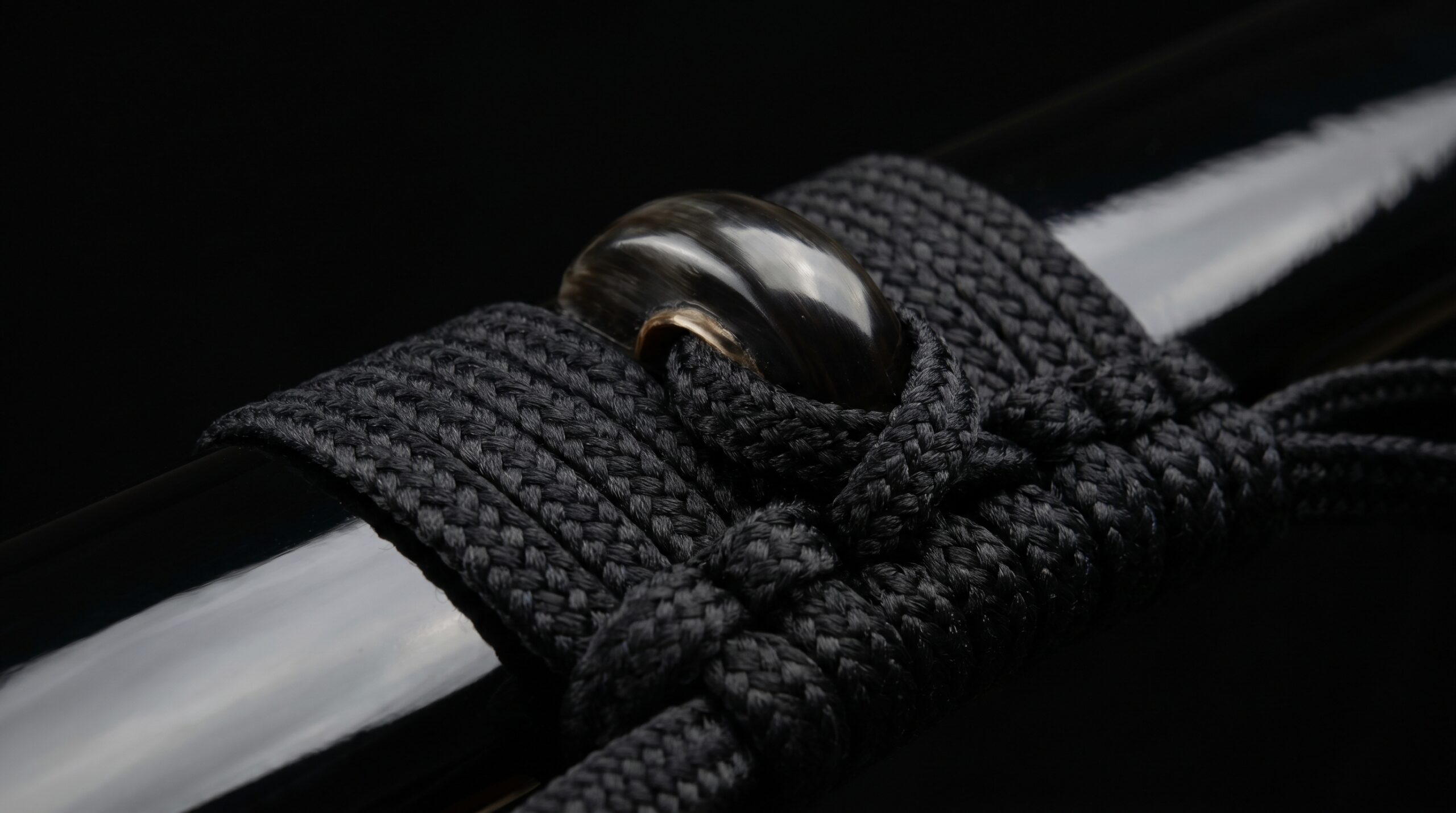
Above, the kurikata of a katana saya with the sageo threaded through its transverse hole. Notice how the knob sits flush against the lacquer surface and how the sageo emerges cleanly without abrading the saya wall. The orientation places the knob on the wearer’s body side when the sword is worn through the obi.
Evaluating, Repairing, and Caring for the Kurikata
When you pick up a katana, run a thumb across the kurikata and pull it gently away from the saya. There should be zero movement. Any wobble means the glue joint or pin has failed and the saya wall behind it is taking unbalanced stress. Look at the transverse hole as well — sageo over time can saw a groove through softer wood, and a worn-through kurikata is a candidate for replacement. On older koshirae, expect to see polish wear on the kurikata where the sageo has rubbed for decades; a uniform burnish is normal, a deep groove is not.
For care, treat the kurikata the same way you would treat the rest of the saya: dust with a soft cloth, avoid excessive humidity, and keep oils off the surface. If you replace your sageo, thread it through the kurikata gently to avoid abrading the inside of the hole. A loosening kurikata should be reseated by a saya specialist — DIY epoxy is the fastest way to ruin both the fitting and the wood under it. For broader saya care, our maintenance guide covers humidity, storage, and oiling.
Frequently Asked Questions About the Kurikata
Where exactly is the kurikata placed on the saya?
The kurikata sits on the omote side of the saya — the side that faces outward when the katana is worn through the obi — and is positioned 6 to 8 centimeters below the koiguchi for a standard adult-length blade. The exact distance depends on the wearer’s preferences and on the draw style being practiced; some iaido schools specify slightly higher placement so the sageo crosses the body at a particular angle. The orientation is universal: the transverse hole runs perpendicular to the blade so the sageo can be tied around the obi cleanly.
What is the difference between kurikata and kurigata?
None — they are two romanizations of the same Japanese word, 栗形. Kurikata reflects a more literal reading and is more common in modern Japanese sword literature, while kurigata is sometimes seen in older Western sources and remains in use among English-speaking collectors. Both refer to the same chestnut-shaped knob on the saya. If you encounter both spellings in different texts, do not assume they describe different fittings; they are interchangeable. Our broader saya literature uses both spellings depending on context.
Can you replace a damaged kurikata?
Yes, but it is a saya-shi job, not a do-it-yourself one. A replacement kurikata must be matched to the existing saya in wood species, lacquer color, motif, and dimensions, then carefully fitted into the original recess without enlarging it. Hobbyist replacements often look obviously wrong because the new knob sits proud of the lacquer surface or is glued into a hastily widened hole. On a historically important koshirae, replacement work should be documented because it can affect provenance and appraised value. For modern reproduction katana, swapping a kurikata is straightforward through a customizer.
To complete your tour of the saya’s named fittings, read our companion guides on the koiguchi at the saya mouth and the kojiri at the saya tip. To configure a complete koshirae with your preferred kurikata style, visit our katana customizer.